
His Very Best: Jimmy Carter, a Life
September 2026
Jimmy Carter occupies a paradoxical space in the American consciousness. For decades, popular memory reduced him to a saintly ex-president who built houses for the poor, neatly separated from the failed executive overwhelmed by inflation and foreign crises. When the historian rejects these caricatures and goes back to the drawing board, a three-dimensional figure emerges: a deeply principled, technically brilliant leader defined by structural achievements at the cost of public approval and the mercy of revolutionary forces. Jonathan Alter’s book His Very Best is the first complete biography of this unlikely Warrior for Peace.
In its 250-year history, fewer than 22 years involved no ongoing wars or combat deployments by the United States military. Jimmy Carter’s tenure as president was one of those rare occasions. Alter wrongly cites Thomas Jefferson as the last president before him who could make that claim. This ignores, however, the First Barbary War against pirates in North Africa and bloody relocations of Native Americans during the Westward expansion. In fact, Jefferson’s Sword of War quote, of which Carter received a plaque upon leaving office, only claims no blood to “fellow citizens”. Jefferson’s contemporary, and later president, John Quincy Adams does fulfill the No War criteria¹ and his anti-imperialist speech warns of going “abroad in search of monsters to destroy” and “becoming the dictatress of the world”. No president apart from John Quincy Adams and Jimmy Carter achieved that restraint, leaving a 150-year chasm filled with foreign interventions, world wars, and continental expansion between the only two leaders who were fortunate and willing enough to keep the nation at peace.
If Jefferson and Carter differ on their record of peace, they align in a rarer way according to Alter. Both were world-class polymaths in the White House. From peanut farmer to nuclear engineer to woodworking carpenter and poet, Carter learned and mastered new skills throughout his life². But much like the earlier argument, it sounds convincing only at first glance. Considering the lack of Renaissance men in the post-World War II era, where technical and artistic occupations became separated and the fields within them insulated, Carter is a truly anachronistic character. His rural childhood, which was technically stuck in the 19th century with no running water or electricity, played a major role in this Do-It-Yourself attitude. A look back into the American chronicle reveals, however, that many presidents matched Carter’s exceptional breadth. The other peace president, John Quincy Adams, for one, was influential in law, diplomacy, literature, science, and academia³. Other contenders include Theodore Roosevelt and Herbert Hoover.
While much of his rural childhood reads like a Mark Twain story of self-reliance and rustic curiosity, that same 19th-century environment in segregated Georgia left a deeper psychological imprint. Surrounded by Jim Crow-era racism, the young Carter remained largely silent, failing to take a public stand during the height of the civil rights movement. This early complacency haunted him. Much of his subsequent drive, beginning with his stunning inaugural declaration as governor in 1971 that "the time for racial discrimination is over" and continuing through his human rights-focused presidency and global humanitarianism, was arguably a lifelong penance: an unrelenting effort to make up for the moral failings of his youth.
It can also be said that Carter was among the least lazy and most honest presidents. When, in a navy job interview, the young lieutenant confessed to Admiral Hyman Rickover that he had not done his best all the time, he would discipline himself to make the maximum effort in every single thing he did. Not just during his seven years at sea, but throughout the rest of his life.
Before the Oval Office tested these virtues, Carter’s earnestness required a political counterbalance on the campaign trail. To soften his image as a preachy, born-again Southern Baptist, Carter executed an unconventional branding strategy: he embraced rock and roll culture. Associating openly with icons like Bob Dylan, Willie Nelson, and the Allman Brothers, he cloaked his highly moralistic rhetoric in a populist, countercultural cool. This alignment helped him capture the youth vote and ride the post-Watergate wave to the White House.
After winning the presidential election, Carter promised the American people that he would never lie to them. And, apart from the occasional truth spinning, kept that promise. But by asking “what is the right thing to do” instead of “what is the politically right thing to do” he inevitably chose unpopular options.
Although personally brokering peace between Israel and Egypt was a historic triumph, Carter alienated both the American Jewish community, due to his insistence on a settlement freeze and his unprecedented advocacy for a Palestinian homeland⁴, and the broader Arab world, which condemned the separate treaty as a profound betrayal of collective Arab unity. Ultimately, while the political fallout cost Carter some approval, it cost Anwar Sadat his life. The Egyptian leader's ability to force through a deeply unpopular but necessary peace stands as one of the rare instances where authoritarian rule was perhaps the only mechanism capable of securing the long-term betterment of a nation.
The list of Carter’s ambivalent choices is a long one.
To deal with the oil crisis, the preaching president requested a car-obsessed consumer society to reduce their energy consumption. He implemented painful high-interest monetary policies to curb inflation which only curbed their enthusiasm. Even achievements such as the avoidance of a war in Central America by giving Panama back its waterway or formally recognizing the People’s Republic of China went unappreciated due to his sober pragmatism over a grand narrative. Critics saw in the Panama Canal Treaties the removal of strategic U.S. infrastructure, and in the recognition of the other “One China”, the betrayal of an ally in Taiwan.⁵ Economic deregulation, often misattributed to Reagan, was Carter's quiet masterstroke that laid the structural foundation of the modern economy by democratizing commercial flight, gutting freight monopolies, and unleashing the competitive supply chains that make globalized commerce possible.
Overshadowing every structural triumph and defeat was Carter’s decision to admit Iran’s deposed Shah into the United States for cancer treatment. Trapped between pressure from establishment hawks like Henry Kissinger and his own humanitarian principles, Carter yielded against his better instincts, prophetically asking his advisors what they would recommend if the embassy was seized. Ruhollah Khomeini’s revolutionaries viewed the gesture not as mercy, but as a plot to orchestrate another military coup, prompting the storming of the U.S. embassy and a 444-day hostage crisis. The agony of American powerlessness was played out on television screens every night as Ted Koppel anchored America Held Hostage⁶, punctuated by the tragic spectacle of Operation Eagle Claw, a botched military rescue that left eight servicemen dead and burning helicopter wreckage in the Iranian desert. Khomeini’s regime held the captives until the precise moment Ronald Reagan concluded his inaugural oath, delivering a final humiliation. Whether Reagan deliberately delayed the release in consultation with Khomeini is a question of ongoing debate as no decisive evidence has been found. Years later, Carter would tell Koppel that only two people profited from the ordeal: the Ayatollah Khomeini, and the anchor himself.
History is often our present politics projected onto the past. Alter’s motivation in writing the life of Jimmy Carter is explicitly tied to his perceived loss of accountability and seriousness in politics following the 2016 election of Donald Trump. The author's personal access to Jimmy and Rosalynn Carter, going back to 1978 when he was an intern in his speechwriting office, doesn’t cloud his scholarly, distant evaluation of the man’s life; it is only when one-sided comparisons to Trump the Terrible and Obama the Decent come up that the writing shifts gears into liberal opinion piece territory. Yet, despite these partisan detours, the center of the text holds.
Alter and fellow biographer Kai Bird⁷ highlight the long-lasting structural decisions made during Carter's single term, viewing his post-presidential reputation as somewhat overrated by comparison. Ultimately, whether the four years of his presidency or the four decades that followed were more impactful depends on one’s criteria. A compelling case can be made for his humanitarian work when evaluated strictly by the millions of lives saved or improved in developing nations.⁸ Both eras share the same convictions. Carter remained a figure of rare intellect and rigid morality whose quiet structural victories, humanitarian dedication, and resolute commitment to peace will outlast the political defeats that once defined him.
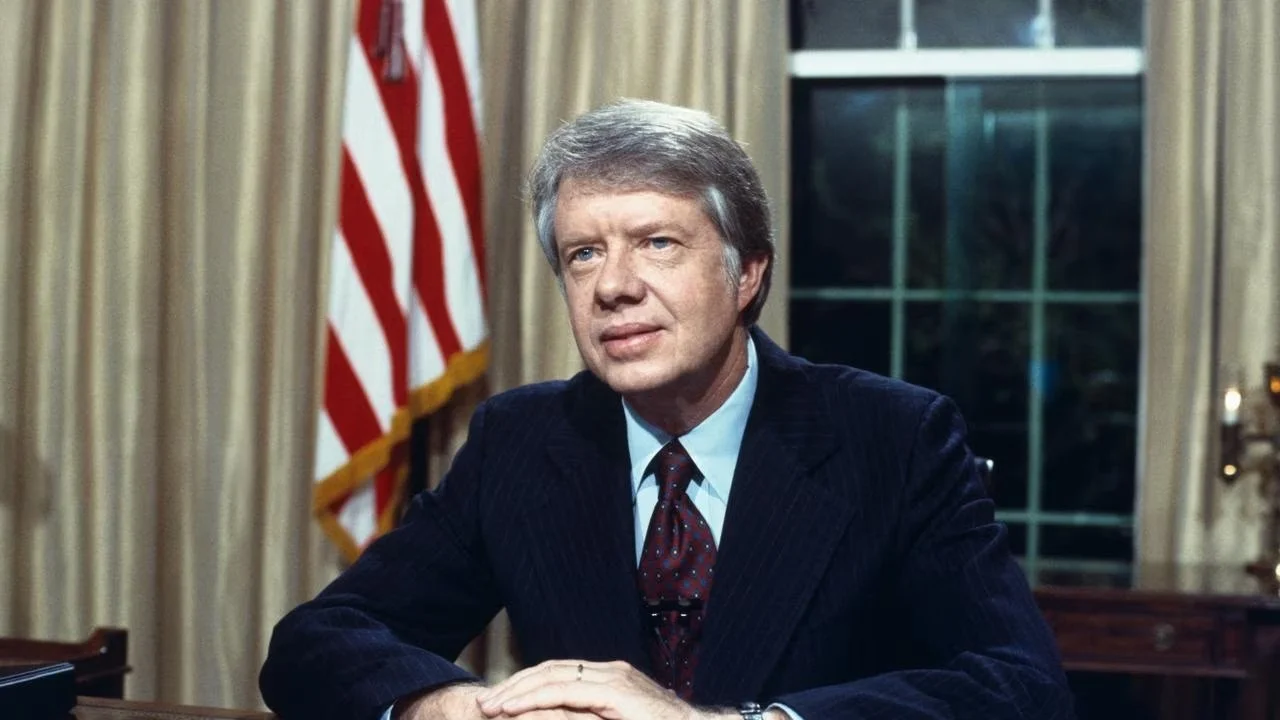
Jimmy Carter in 1977 before his Address to the Nation on Energy
¹ The Winnebago War of 1827 was not an executive war, but a localized standoff triggered by an unauthorized raid that ended without federal combat engagements. Chief Red Bird's followers voluntarily surrendered to civil authorities to avoid a larger conflict, leading President Adams to handle the issue strictly as a peaceful diplomatic and legal resolution.
² Bob Dylan said that it wouldn’t surprise him if his friend was also a racecar driver.
³ During his post-presidential career in the U.S. House of Representatives, he led an eight-year legislative crusade to honor James Smithson's bequest, successfully fighting off opposition to establish the Smithsonian Institution in 1846 to promote scientific inquiry and public education.
⁴ Tensions deepened again with the publication of his 2006 book, Palestine: Peace Not Apartheid, whose controversial title (rather than actual content) sparked outrage for evoking South African racial segregation.
⁵ The announcement to sever formal ties triggered intense protest in Taipei. When Deputy Secretary of State Warren Christopher was dispatched to Taiwan in late December 1978 to negotiate the transition to unofficial relations, his motorcade was attacked at the airport by 20,000 rioters armed with rocks, mud, and sticks.
⁶ The program was renamed Nightline in 1980 and continues to be a hit for ABC.
⁷ For a more policy-dense picture of the White House years specifically, Kai Bird's The Outlier: The Unfinished Presidency of Jimmy Carter, draws heavily on newly unsealed staff diaries.
⁸ Focused on Neglected Tropical Diseases like Guinea worm and river blindness, the Carter Center has delivered over 700 million treatments and reduced annual Guinea worm cases from 3.5 million to near zero.
The life of Jimmy Carter will be visualised in American Portrait through Comic Books and a Feature Film.

