
Nuclear Weapons and Foreign Policy
[Editorial Disclaimer: The following piece is a stylized review written from a historical perspective.]
November 1957
Whenever a new technology comes around, the imagination of the public usually ascribes to it characteristics of the familiar while the technologists of the era promise something unlike anything that came before.¹ Usually the public is correct.
An army from the War of the Spanish Succession from 1701 would have little problems understanding the weapons and tactics of an army from 1815 at the Battle of Waterloo. While the weapons became more sophisticated, the fundamental conduct of war didn’t change even after the Industrial Revolution. It is because of this slow evolution in combat that the world has difficulty coming to grasp with a true revolution: the atomic bomb.
Dr. Henry Kissinger’s second book Nuclear Weapons and Foreign Policy sketches out a framework that aims to turn the nuclear threat into a nuclear opportunity for American policymakers. While provocative, the arguments laid out are neither entirely new nor a singular effort by the author. Instead they are the result of a focus group at the Council of Foreign Relations of which large parts have appeared in their publications.²
What is novel however, is the depth of the argument; the fluidity with which Kissinger navigates technicalities of atomic warfare and the psychological aspects driving leaders and their population. Beyond the academic walls, the book is also making waves in the White House with Vice President Nixon seen carrying a copy and reaching out to the Harvard professor.
The issue at heart is the inflexibility of options that leads to paralysis. While the Soviets, now possessing nuclear parity, keep advancing in Eastern Europe, Arabia and Indochina, the only responses on the U.S. side would be a costly Limited Conventional War (as in Korea), an Unlimited Nuclear War (leading to the possible destruction of civilization) or inaction (resulting in further Soviet advances).
It is reasonable that the more powerful weapons have become, the greater is ones reluctance to use them. This fact is skilfully exploited by the Soviets who keep their conquests below the levels of agitation while promoting “peace campaigns” to stir up internal opposition. The American empiricist mind also cannot comprehend the radical transformations envisioned by communist doctrine. In this sense, the authors doctoral dissertation about 19th century European statecraft as well as his historical experience in World War II serves as a prologue. Whether Napoleon, Hitler or Stalin, their aim was never legitimacy in the current system but, true to revolutionary doctrine, an erosion of the entire system.
To solve these issues, Kissinger advocates for the option of Limited Nuclear War. What at first seems like an oxymoron should give the American side a proper response to Soviet aggression without resulting to Unlimited War. It should be thought of less like land warfare, in which the conquest of territory through large armies is the main goal, and more as a sea battle. Small self-contained units would unleash their great firepower for a fast destruction of enemy forces.
By reorganising the military command into a Tactical Force for Limited Nuclear War, a Strategic Force as a last deterrent, as well as through communicating ones objectives to the enemy, Kissinger believes that engagement, even with nuclear weapons does not escalate to the destruction of civilisation. In fact, compared to a Conventional War that slowly raises the stakes and might spiral out of control, the new framework would establish its limitations upfront. It is unclear however if these self imposed limitations apply to each party equally. The Soviets greater willingness to run risks and rejection of diplomatic obligations should not put the hopes too high.
In an analysis of handwritten notes, the Soviet thought becomes more clear. Lenin views war as “part of the whole” of politics in which “appearances are not reality”. Instead of being a last resort, wars are part of the communist struggle and should be conducted whenever the relation of forces is favourable. Khrushchevs adaption of peaceful coexistence can be aligned with the more belligerent Lenin who would often paraphrase Clausewitz: “The conqueror is always a lover of peace. He would like to enter territory unopposed.”
Against prevailing notions, the Gordian Knot of Nuclear Tension cannot be cut through by a symbolic world authority such as the United Nations. Its hand would still be made up of the two superpowers, making an effective slash nearly impossible. Although more hopeful in name, the World Peace Movement makes the author even more pessimistic as it represents a psychological warfare operation by the Soviets to hamstring Americans through their own preconceptions. While it is true that the World Peace Council³ is a direct Soviet operation with no intention of banning their own bomb, dismissing the entire, largely grassroots movement, instead of engaging with it is a lost opportunity if policies were to be made on a moral foundation.
The choice for Limited Nuclear War by Kissinger also comes from the American experience. Although it lacks the wisdom of a long history and currently celebrates the over specialised expert inside a dysfunctional bureaucracy, its great strength comes from self-reliance, spontaneity and initiative that no Soviet Military Academy could replicate. Because the key to survival in a Limited Nuclear War lies in a dispersal of units and of success in mobility Americans are psychologically equipped for it. The military manifestation of this individualism will be the flying platform, transporting single soldiers through the air.
The authors maxim that one should use the smallest amount of force consistent with achieving the objective is especially important when bringing the deadly capabilities of the new bombs to mind:
A 20 megaton thermonuclear bomb represents the same order of increase in explosive power over the atomic bomb exploded at Nagasaki as the Nagasaki bomb did over the largest blockbuster of World War II, that is, a thousand fold increase.⁴
The mutual terror resulting from this has the paradoxical effect of leading to an equilibrium in terms of national survival. It may however doom Non-aligned countries to a fate determined by the most ruthless player when peace is the Americans only objective and when no intermediary military options exist.
Kissinger views the punishment of Prometheus for stealing the fire from the gods as adequate because of the horrors it would unleash on humanity. Having stolen the fire, the job of the statesman now is to have a better foresight and initiative, that is make decisive decisions without full knowledge but with an awareness for the risks they entail. In that sense Prometheus serves as a role model for his foresight. A foolish path would be that of the titans brother Epimetheus. To wait for events to pass only to be knowledgable in hindsight with outside forces shaping the world. In either case, the box of Pandora has opened.
The authors historical references and unique arguments are more compelling than the style they are presented in. Same concepts are introduced countless times because the foundational articles, that assume new readership, are largely left unaltered.⁵ Nevertheless the importance of the subject matter and intellectual rigour of Kissinger and his associates⁶ makes for an engaging thesis. The critic, perhaps a member of the Eisenhower administration, will call the book a dangerous invitation to a “limited” atomic disaster, while the new school of strategic realists might counter with the necessity of flexible responses that links power to policy. Only the unfolding of this century will prove which of them has grasped the nature of the fire.
¹ Apart from genuine belief, this also serves the purpose of securing funding from academia or industry.
² The article Military Policy and Defense of the "Grey Areas” published in 1955 not only introduced the concept of Limited Nuclear War to readers but also launched Dr. Kissingers career as a public intellectual.
³ For those with a penchant for creative coverage, one might consult the information bureau of the World Peace Council.
⁴ Government official Paul Nitze critizised the book for miscalculating the blast effect of certain weapons, using “the cube root of their stepped-up explosive power” instead of “the square of the cube root” that is less destructive.
⁵ Even single phrases might tire the close reader. For example “To be sure” is used 92 times throughout the text.
⁶ Ranging from study group chairman Gordon Dean to outside expert Robert Oppenheimer, the “Father of the Atomic Bomb”.
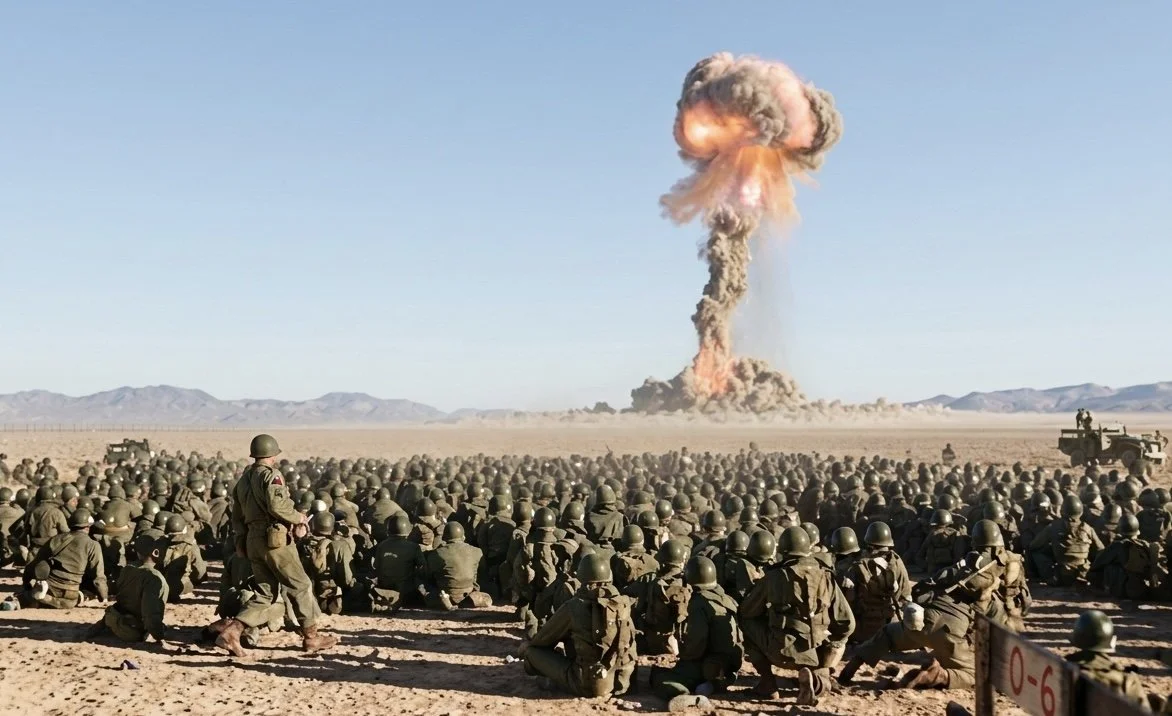
This recolored image shows the “Dog” test conducted at the Nevada Test Site in 1952 as part of the Operation Buster–Jangle.
The sweep of contemporary history unfolds: See the Cold War come to life in American Portrait.

